
Online Financial Data Connection ("Online pénzügyi adatkapcsolat") automatically transfers invoices, receipts and other financial data from Számlázz.hu to your accounting software.
Once enabled, data is sent automatically whenever documents are created or updated, so there's no need to export files or transfer data manually.
Online Financial Data Connection is included in the #profi subscription package.
Users with Account Owner, Administrator, Accountant, or Operator permissions can set up the Online Financial Data Connection.
What is Online Financial Data Connection?
Online Financial Data Connection automatically transfers invoice, receipt and accounting data from Számlázz.hu to your accounting software or other supported business systems. Whenever a document is created or updated, the latest information is sent automatically.
Depending on the connected application, data can be sent to:
- accounting software
- ERP systems
- CRM systems
- financial management applications
- other supported business software
Instead of downloading files or forwarding invoices manually, the data is transferred automatically whenever relevant changes occur.
What data can Online Financial Data Connection transfer?
Online Financial Data Connection can transfer all of the data listed below. The data actually received and processed depends on the capabilities and configuration of the receiving system.
- outgoing invoices
- incoming invoices
- proforma invoices
- advance invoices
- final invoices
- cancellation (reverse) invoices
- delivery notes
- receipts
- bank transaction data (in case using "Autokassza", automatic payment status management using imported bank transactions)
- Changing the payment status of the invoice
- Changes to account details that can be modified later, namely:
- Date of accounting
- Customer general ledger number
- Customer general ledger identifier
- Revenue or VAT general ledger account for each invoice item
- Accounting event or VAT accounting event for each invoice item
When is data sent to the connected system?
Data is transferred automatically whenever a document is created or whenever relevant information is updated. This ensures that the connected system always receives the latest available data.
Examples include:
- issuing a new invoice
- changing the payment status
- updating accounting information
- adding or modifying general ledger accounts
- updating accounting event information
Which external systems are already integrated with Számlázz.hu?
Számlázz.hu is already integrated with a growing number of accounting, ERP and other business systems, including:
- Acounto
- Adriana Accounting
- AOC System
- Ár-Túr Könyvelés
- Brite
- Business Health Monitor
- Cadren
- Cashbook
- Clement Weaver
- Cogentax
- ControlliQ
- DocFinIT
- Eniac Computing
- Eszerződés.hu
- Finistic
- Hepp Könyvelő Cégcsoport
- IMA ERP
- Innonest
- Kontiroll
- Konto Online
- Kulcs Connect
- Nagy Machinátor
- NetAccounting
- Novitax NTAX
- Novitax TAXA
- Péntech
- QualitySoft
- QUiCK
- SMARTBooks
- Skonto Platform
- Távügyviteli Kft.
- The Management
- WebTax
- Zeuss
The list of supported systems is continuously expanding. If your accounting or financial software is not listed, contact your software provider and ask whether they plan to support Számlázz.hu's Online Financial Data Connection. They can implement the integration using our developer documentation.
Until the integration is available, you can still export invoice data manually and import it into many accounting systems via the menu "Listák / Főkönyvi adatexport".
How do I enable or disconnect Online Financial Data Connection?
You can configure the connection via the menu "Beállítások / Fiók beállítások / Online pénzügyi adatkapcsolat" (Settings / Account settings / Online Financial Data Connection).
Select your accounting or financial system and paste the API key provided by your accounting software or service provider into the connection settings to establish the connection.
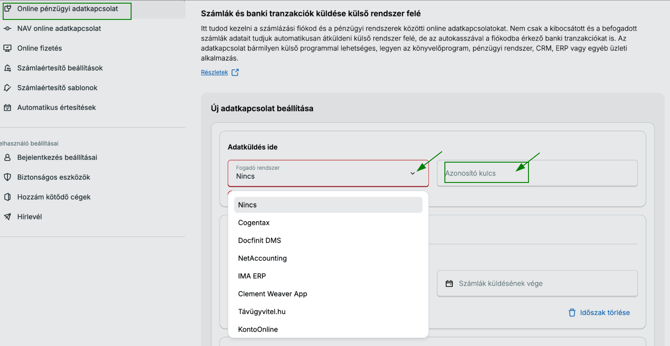
Then choose the start date for data transfer. You can enable or disable the transfer of invoices, receipts and bank transactions individually, depending on which data you want to send to the connected system.
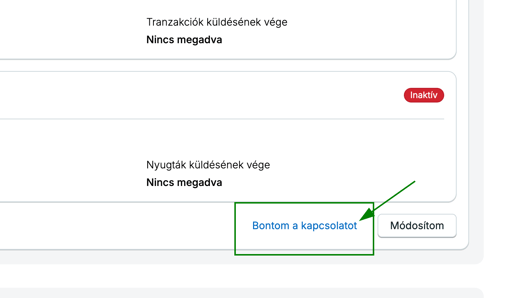
If you no longer need the integration, you can disconnect it via the same menu by clicking on "Bontom a kapcsolatot" (disconnect).
How can I forward invoices imported from NAV to my accounting software?
If you use "Számlaverzum" function and receive supplier invoice data from the NAV Online system, these invoices can also be forwarded to your accounting software.
External invoice data transfer can be enabled via the menu "Beállítások/ Fiók beállítások / NAV online adatkapcsolat" (Settings / Account settings / NAV Online Data Connection).
Turn on: "NAV-tól lehívott számlák továbbítása a könyvelői rendszerek felé"
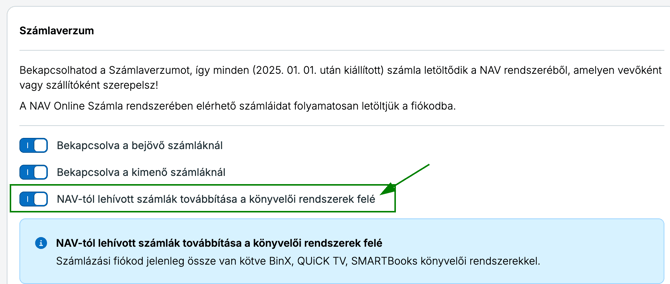
Forwarding invoice data received from NAV is an additional setting and is disabled by default, even if Online Financial Data Connection is already enabled.
What are the benefits of using Online Financial Data Connection?
Using automatic data transfer offers several advantages:
- your accountant always can check up-to-date information
- no manual invoice exports or email attachments needed
- prompt administration
- faster bookkeeping
- more accurate payment tracking
- reduced risk of manual errors