
Third-party invoicing lets one business issue invoices on behalf of another. It is commonly used when one company manages the invoicing process for another.
Számlázz.hu supports both third-party invoicing and self-billing. This article explains how these solutions work, what legal requirements apply, how to set them up, and what costs you should expect.
What is third-party invoicing and what is it used for?
Third-party invoicing means that one business (the delegate) issues invoices on behalf of another business (the supplier).
Although the delegate creates the invoice, the invoice is always issued in the supplier's name and with the supplier's tax information. The supplier remains responsible for the invoiced transaction and its tax obligations.
This solution is commonly used by businesses such as:
- food delivery platforms that issue invoices on behalf of restaurants,
- transport companies that invoice on behalf of independent drivers,
- ticketing services that issue invoices on behalf of event organizers,
- online marketplaces that invoice on behalf of their merchants,
- other service providers that manage invoicing for multiple businesses.
How is self-billing different from third-party invoicing?
Self-billing is a special type of third-party invoicing.
Instead of the supplier or another authorised business issuing the invoice, the buyer creates the invoice on behalf of the supplier.
Invoices created through self-billing must comply with the applicable legal requirements and clearly indicate that they were issued using the self-billing procedure.
In Számlázz.hu, invoices created through a self-billing relationship are automatically marked with the required "Self-billing" label.
| Feature | Third-party invoicing | Self-billing |
|---|---|---|
| Who issues the invoice? | Delegate | Buyer (acting as the authorised delegate) |
| On whose behalf? | Supplier | Supplier |
| Written agreement required | ✔ | ✔ |
| Automatic "Self-billing" label | ✖ | ✔ |
| API supported | ✔ | ✔ |
Learn more about third-party invoicing and self-billing in our API documentation.
How can I create a third-party invoicing relationship manually?
If you issue invoices manually from the Számlázz.hu interface, you can create the relationship directly from your invoicing account.
- Log in to the account that will act as the delegate.
- Go to Vezérlőpult and open the "Csatlakozni szeretnék egy céghez" widget (Dashboard / Join an existing company).
- Search for the supplier by tax number or full company name (the search requires an exact match).
- Select Third-party invoicing and send the request.
- The supplier receives an email notification and accepts the request from their own account.
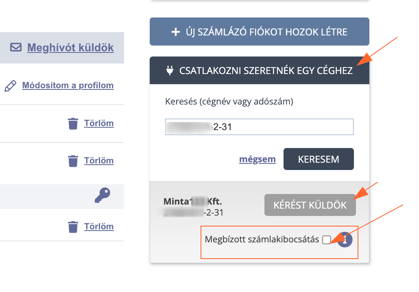
Once the request has been accepted, the logged-in user is authorised to issue invoices on behalf of the supplier.
The delegate is the company that issues invoices on behalf of the supplier. The connection itself is tied to the user account (email address) that sent the request. We recommend creating a dedicated user for this purpose in the delegate's account, especially if you plan to issue invoices through the API later.
How can I create a third-party invoicing relationship through an API connection?
API integration is the recommended solution if you issue invoices automatically, for example from a webshop, ticketing system or another business application.
First, connect your application to your own Számlázz.hu account using Számla Agent (API).
- Generate a Számla Agent (API) key in Dashboard / Számla Agent keys.
- Configure your webshop or business application with the generated API key.
This establishes the API connection between your application and your own Számlázz.hu account. Please note that the Számla Agent (API) key can only be used for issuing documents in your own account. Third-party invoices and receipts are always issued with the username (email address) and password of the dedicated user created for the supplier connection, not with the API key.
Managing third-party invoicing relationships through the API (sending connection requests and creating supplier accounts) requires a separate permission. Please contact our Customer Support team, and we will enable this functionality for your delegate account.
Once the function is enabled, your application can:
- send third-party invoicing requests to existing supplier accounts, or
- create new supplier accounts (if they do not already exist) and then send the third-party invoicing request automatically.
When sending a third-party invoicing request through the API:
-
the partner is identified by their tax number,
-
if a Számlázz.hu account already exists, the system sends a connection request to the partner by email,
-
if no account exists, the system creates a new account and sends the partner an account activation email.
Make sure the tax number is entered exactly as registered: if it does not match the tax number stored in an existing account, the system will create a new account instead of sending a connection request.
👉 The third-party invoicing relationship does not become active immediately.
After the request has been sent, your partner receives an email notification. The relationship becomes active only after the partner has accepted the third-party invoicing request.
Until the request has been approved, the dedicated user account cannot access the supplier account and no third-party invoices or receipts can be issued.
Any attempt to issue third-party invoices or access the supplier account before the request has been approved will fail.
How do I manage multiple supplier accounts for third-party invoicing?
A user account used for third-party API calls must have access to exactly one account: the supplier account. If the user also has access to any other account (for example the delegate's own account), the API calls will fail. If you created the connection manually from the Számlázz.hu interface, remove the requesting user's access from the delegate's own account before using it for API calls.
Therefore, you must create a separate username (email address) and password for each supplier account that you want to access through the API.
For example, if your email address is sample@company.com, you can use addresses such as:
sample+co1@company.comsample+co2@company.comsample+co3@company.com
Using email aliases helps you to manage multiple supplier accounts while keeping a separate user account for each one.
The Számla Agent documentation for developers contains detailed information about sending third-party invoicing requests through the API.
The Számla Agent (API) key only connects your application to your own Számlázz.hu account. Third-party invoicing permissions are configured separately. Each supplier account requires its own dedicated user account (username/email address and password).
Can I issue receipts on behalf of another business?
Yes. In addition to invoices, authorised delegates can also issue receipts on behalf of another business.
Computer-generated receipts may only be used by businesses that are not required to operate an online cash register under Hungarian legislation.
You can issue receipts both from the Számlázz.hu interface and through the API. Issuing receipts through the API requires a paid Számlázz.hu subscription for the delegate account; it is not available with the free plan.
What does third-party invoicing cost?
Third-party invoicing is available as an additional service.
The delegate account (the business issuing invoices on behalf of others) pays for the service. The supplier account can use any Számlázz.hu package, including #free.
Depending on the services you use, the total cost may include:
- your Számlázz.hu subscription (monthly or annual),
- the fixed monthly fee for the Third-party invoicing service, which is independent of the number of connected supplier accounts,
- the monthly Számla Agent fee, if you issue invoices through the API. This fee is based on the number of invoices created automatically during the month.
For current pricing, visit our Terms and Conditions page or read this knowledge base article.
Frequently asked questions about third-party invoicing and self-billing
-
Does the supplier need a paid subscription?
No. The supplier can even use a #free account. The additional third-party invoicing service is subscribed to by the delegate.
-
Can one delegate issue invoices for multiple suppliers?
Yes. A single delegate account can manage multiple third-party invoicing relationships. It does not affect the fixed, monthly third-party invoicing fee.
-
Can multiple delegates issue invoices for the same supplier?
Yes. A supplier may authorise more than one delegate if required.
-
Can a third-party invoicing relationship be terminated?
Yes. The supplier can terminate the relationship at any time by removing the delegate's dedicated user from their account on the Dashboard. On the delegate's side, the dedicated user can leave the supplier account in their own user settings. Invoices that have already been issued remain in the supplier's account.
-
Can the third-party user see all of my invoices?
No. The authorised user can only access the invoices they have issued on your behalf. You can continue issuing your own invoices from the same Számlázz.hu account, and the authorised user will not have access to them.
-
Can the delegate issue invoices in bulk?
Yes. If you need to issue multiple invoices on behalf of the same supplier, you can use the Bulk invoicing feature and import the invoice data from an Excel (CSV) file.
Learn more about Bulk invoicing in our knowledge base.
-
Can I use third-party invoicing as a white-label solution?
Yes. When integrated through Számla Agent (API), third-party invoicing can operate as a white-label solution.
Your customers only need to create and verify their Számlázz.hu account during the initial setup. Once the connection has been established, invoices can be issued automatically from your platform, so your customers do not need to log in to their Számlázz.hu account during day-to-day operation.
Your platform remains the primary interface for your customers, while Számlázz.hu handles the invoicing in the background.
Before using third-party invoicing or self-billing, you must have a written agreement with your supplier or principal. As the invoices are issued by a party other than the taxable person, a written agreement is required by law.
You can find a sample agreement template in Hungarian at this link.